Why BIM Initiatives Fail in Most Companies and How to Overcome the Challenges

BIM is mostly adopted in the AEC industry.
But despite this widespread adoption, the question remains:
Why do most BIM projects fail to deliver real value?

Today, most companies say they “use BIM.”
But in most cases, this means that the company does not have a structured process, managed streamline
Rather, they have a fragmented system of models, tools, and workflows.
And this is where the problem reveals.
What is BIM Failure?
BIM failure is not the absence of models or tools.
It is the absence of structured IM (information management) .
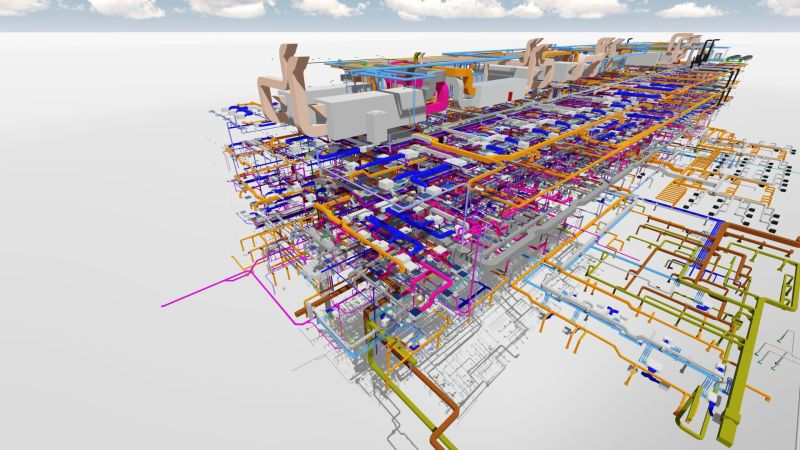
It means that the project may have excellent 3D models, several disciplines, and the best software tools.
Yet, the project may not be working as a BIM-driven process.
BIM is not defined by what is produced.
It is defined by how information is created, managed, and transferred.

Symptoms of BIM Failure
BIM failure is not immediately apparent. It manifests itself over a period of time through a series of recurring symptoms:
— Coordination meetings that don’t solve problems
— Frequent model updates without clear rationale
— Information not available when needed
— Clash detection without subsequent action
— Reliance on people rather than systems
This series of recurring symptoms ultimately translates to:
— Delays
— Increased costs
— Trust issues between different stakeholders
And ultimately, a digital process that is really not.
Why BIM Fails: Three Core Reasons
From an information management point of view, BIM failures stem from a series of three primary reasons:
1. Lack of Clear Information Requirements
At the heart of every BIM process, there's a simple question:
What information is needed, when, and by whom ?
In most projects, this question never gets a clear answer.
If information requirements are not defined:
- The process is conducted on assumptions.
- The information generated is either too much or too little - not fully accurate.
- The information generated lacks consistency.
Some of the key concepts in BIM, such as:
- Employer Information Requirements (EIR)
- BIM Execution Plan (BEP)

are either absent, misunderstood, or merely ticked off as a formality.
As a result, the process creates models, but not meaningful information.
2. Disconnected Project Processes
A BIM process, as a whole, connects the entire project process:
Design → Coordination → Construction → Operation

However, in most organizations, these project processes are disconnected.
- Designers are concerned with geometry.
- Coordination occurs late in the process or reactively.
- Construction occurs as a rebuild or reinterpretation of information.
What we get from a disconnected process is:
- Rework
- Lack of information
- Inconsistency between different disciplines
This defeats one of the core promises of BIM:
- Continuity of information
3. Lack of a Shared Language
BIM is often described as a collaborative process.
But collaboration requires a shared understanding.
In reality:
— Architects think in terms of design intent
— Engineers think in systems and performance
— Contractors think in sequencing and execution
Without a shared BIM language:
— Definitions vary
— Expectations differ
— Miscommunication increases
In this context, BIM becomes:
A translation problem rather than a coordination solution.
A Real-World Scenario
Consider a typical project:
A coordinated model is delivered.
Clash detection has been performed.
Reports have been generated.
Yet on site:
— Conflicts still occur
— Teams request clarifications
— Elements are reworked
Why?
Because:
— The model did not contain the right level of information
— Issues were identified, but not managed as decisions
— There was no clear link between digital output and site execution
This is not a modeling issue.
It is an information management failure.
How to Fix It: A Shift in Approach
To improve BIM outcomes, we don’t need to improve our BIM tools.
To improve BIM outcomes, we need to improve our BIM questions.
Instead of asking:
“How can we model this better?”
We should ask:
— What information is needed at each stage?
— How does this information flow between all the different stakeholders?
— Who is responsible for this information?
A Structured Approach to BIM
To get from fragmented BIM to successful one, we need to align three things:
1. Define Information Clearly
— Establish Requirements Early (EIR)
— Align BIM deliverables with overall project goals
2. Connect Processes
— Ensure continuity between design and construction
— Don’t have fragmented workflows
3. Build a Shared Language
— Standardize definitions
— Align expectations between disciplines
Insight
BIM is not failing.
**It’s not failing because it’s too complicated.
**It’s not failing because people don’t understand it.
BIM is failing because we don’t use a structured approach.

When we use BIM as a tool:
— It adds complexity
— It gives a false sense of security
— It masks underlying problems
When we use BIM as a system:
— It reduces uncertainty
— It improves coordination
— It improves decision-making
Conclusion
BIM is not failing.
Our approach to BIM is.
A Question Moving Forward
Are we creating models…
Or
Are we managing information ?
At TAPA Parametric Architecture,
we understand that BIM is a structured information system that enables connections between people, processes, and decisions throughout a complete project lifecycle.
Clarity is not a result.
It is a system.
I TAPA Parametric Architecture


Comments